


Fungal infection very often affects toes or nails.This disease affects adults and children.To avoid the chronicity of the pathology, you need to know the signs of foot fungus and what such a disease looks like.
Main signs of the disease
Among all skin diseases, mycosis of the feet is the most common.You can catch the disease by neglecting basic hygiene rules.Sometimes it is very difficult to cure the fungus.
For each person, foot fungus begins and develops in its own way.Here are the most common signs by which you can recognize foot fungus:
- characteristic cracks appear between the toes;
- You can tell that a fungus has appeared by the characteristic itching on the legs and between the toes;
- the skin of the feet is very dry, often peels and becomes rough;
- blisters appear between the fingers, which burst when destroyed;
- the infection can spread to neighboring areas;
- reddish spots appear on the skin, which cause significant discomfort;
- Fungi on the feet can also be recognized by the unpleasant smell.

important!
When the first symptoms of the disease appear, you should immediately consult a dermatologist.If you do not do this in advance, the treatment of the fungus will be much more difficult.
Signs of fungus depending on the type of pathogen
This disease develops due to various types of pathogens.Symptoms of foot damage will vary from case to case.
- If yeast fungus develops on the feet, the nail gradually thins and peels off from the bed.The skin of the foot is hyperemic (takes on a red hue).
- With the development of epidermophytes, the nail turns yellow and becomes covered with spots.The skin on the feet peels and emits an unpleasant smell.A characteristic symptom of this type of fungus is increased dryness of the skin.
- When molds appear, the nail plate can suddenly change color.The skin turns red if the pathogen gradually spreads over the entire foot.One is worried about itching and the skin may crack.In this case, pain and other unpleasant sensations appear when walking.
Only a doctor can determine the type of pathogen.This cannot be done at home.And if you practice self-medication, you can only harm yourself.Your feet will suffer from this, and the skin fungus will spread more and more.

Signs of some forms of fungus
Depending on the affected area and the degree of development, several forms of pathology are distinguished.Everyone's symptoms are different.By knowing the early signs of foot disease, you can start timely treatment of mycosis.
- Interdigital dermatophytosis is the most common stage of the disease.It becomes more active in spring and summer, when the feet sweat the most.Cracks and sores appear between the fingers.You can notice the presence of scales on their skin.The leg looks perfectly healthy.Often a person feels itchy.
- The deleted form is manifested to the least pronounced degree.Peeling is noticeable between the fingers.At this stage of the disease, a sharp unpleasant smell spreads from the feet: it appears due to increased activity of bacteria.
The disease can appear in different forms.Let's get acquainted with their signs, so that we know how to recognize foot fungus and, if it develops, start treatment.It must be remembered that in an advanced stage of the disease the nail is completely destroyed.Its recovery is almost impossible.
Squamous type
This fungus is characterized by intense peeling of the epidermis.In addition, the areas of skin between the toes and the lateral part of the foot are most intensely affected.There are no signs of the inflammatory process.In the photo of the first signs of foot fungus, areas of hyperemia are noticeable.A flat-celled fungus looks like this:
- the stratum corneum thickens;
- skin shines, sometimes becomes thick;
- the pattern on the skin becomes more distinct;
- the fungus gradually spreads to the fingers, the entire leg and affects the nails;
- sometimes lamellar scales appear on the epidermis;
- The patient does not experience any other unpleasant sensations.
Dyshidrotic type
With this fungus, small blisters filled with fluid appear on the skin.They are usually located on the side of the leg.Then they gradually move to the inside of the fingers.How to recognize foot fungus of the dyshidrotic type:
- the balloon is usually single, but if there are many of them, they merge into one big one;
- if left untreated, the fluid in the blisters gradually darkens;
- If the blister bursts, a crusted erosion appears in its place.
Pay attention!
With this type of athlete's foot, there is a very high risk of bacterial infection.The infection enters the body through open skin lesions.
Intertriginous type
This type of fungus is the most common.Initially, a person does not feel any symptoms.Up to a certain point, the skin of the toes does not change.Subsequently, cracks and layers appear.The skin is not affected, but may sweat.
Candidiasis of the feet
The characteristic symptoms of this fungal infection are as follows:
- the lesion is the 3rd or 4th toe;
- the skin is red and swollen;
- There is a blister around the lesion where there is a peeled layer of skin;
- There are pustules and blisters nearby.
important!
If a bacterial infection enters the affected area, this leads to an increase in local temperature.Swelling is noticeable on the skin of the legs.In severe cases, a person experiences general hyperthermia.
Signs of a fungal nail infection
A person's toenails can also be affected.The disease can be distinguished by the following symptoms.
- Pronounced change in the color of the nail plate.Depending on the type of pathology of the patient, the nail acquires different shades.Sometimes it can change only on part of the nail plate.
- Falling nails.It happens only in the advanced stage.If the nail is completely infected, it is destroyed.
- Changes in the structure of the nail.
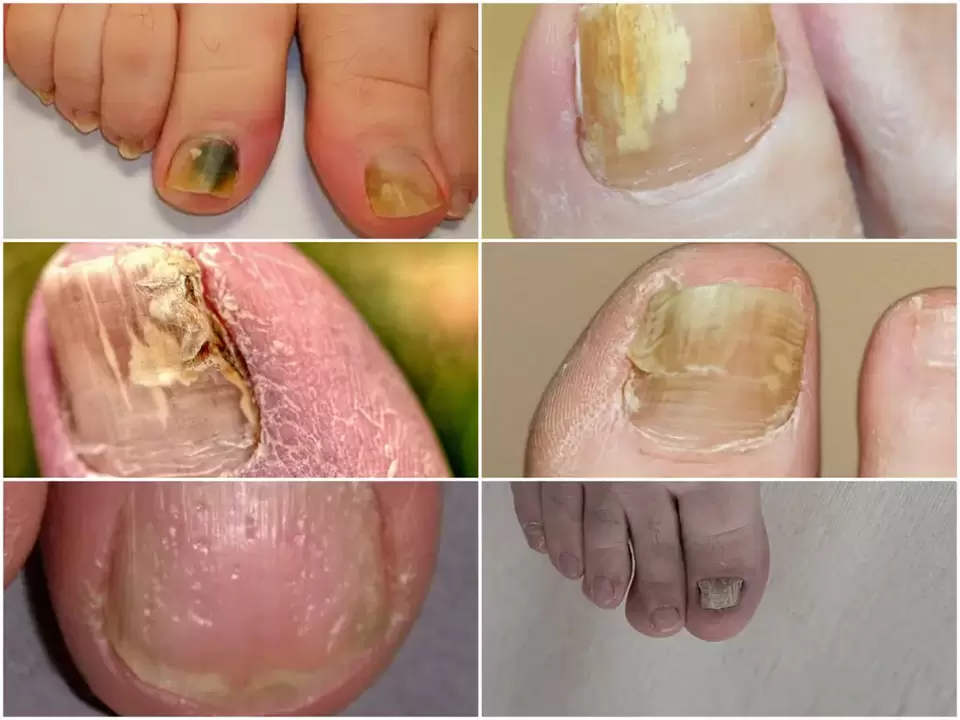
There are several types of onychomycosis, a fungal nail infection.
- Atrophic appearance.The nail plate looks very thin.It darkens, sometimes acquires a gray-brown color.The nail gradually separates from its bed.The skin underneath keratinizes and becomes loose.
- In the normotrophic form of foot fungus, the plate changes color.Spots appear on it - white, yellow, green and even black.The structure of the nail is not affected.
- In the hypertrophic form, the plaque gradually thickens and becomes porous.The affected area looks very unsightly and in some cases causes pain when walking.Removed crumbles and falls without treatment.
Some types of onychomycosis
Depending on the degree of spread of the disease, its forms are distinguished.
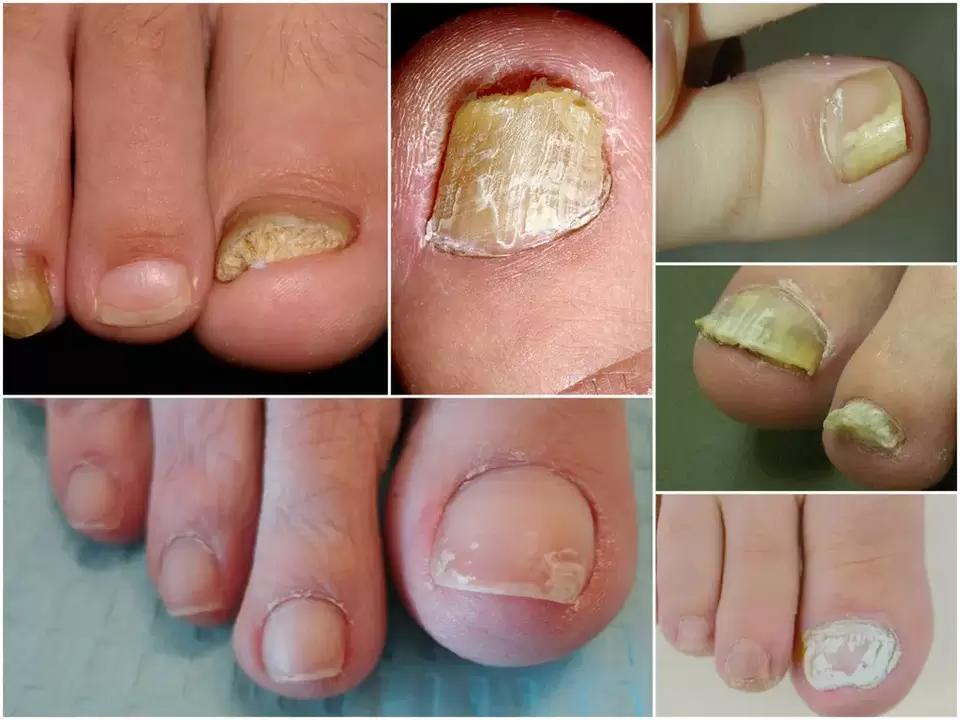
- Lateral onychomycosis is the most common.First, a small yellow spot appears on the free edge of the nail.In the future, you will notice how it increases and the nail plate thickens.When walking, a person feels discomfort.The spread of an unpleasant odor is noticed.Lateral onychomycosis is difficult to treat.
- Superficial onychomycosis is characterized by damage to only the upper layers of the plaque.It does not compact, but becomes chalky over time.
- The rarest form of the disease is subungual onychomycosis.The skin thickens noticeably in the nail fold.The nail turns white and loses its transparency.
General principles of treatment
Any treatment of pathology begins with a diagnosis.Only then can a suitable medicine be prescribed.Self-medication usually leads to worsening of the condition of the feet.Let's get acquainted with the most common methods of therapy.
- At the first signs of a fungal infection, special varnishes, plasters, ointments and sprays are used.They should be used for a long time and according to the instructions.
- If local therapy is ineffective, complex antifungal drugs are prescribed.They are used orally.
- Surgical removal of the affected nail.
- Laser therapy.
- In advanced forms of the disease, systemic drugs are prescribed.
You can avoid the appearance of an unpleasant disease by following the rules of hygiene.You should avoid using foreign products for personal hygiene (towels, slippers).When the first signs of the disease appear, you should immediately consult a doctor.